
Toms River Previous Residents Sources
One Toms River address can be traced through several records, but each source answers a different time question. The recorded deed index identifies transfer parties and legal parcel details. Phone directories and cataloged city directories can place a listed household or address in intervening years. Census, newspaper, map, and probate material can then test a gap or a change. None of these sources should be read as a full list of everyone who lived in a structure.
| Source | Years It Covers | Where Held | What It Shows |
|---|---|---|---|
| Ocean County deed index | Index stated from 1977-04-01 to present | Ocean County Clerk SearchNG | Recorded transfer parties, instrument and book/page data, consideration, legal description, and parcel fields. |
| OCHS phone directories | 1956-57; 1970-2007; 2010; 2014 | Ocean County Historical Society | Telephone and address evidence; editions and missing years need staff confirmation. |
| OCL city-directory subjects | 33 subject items and 12 microform; exact local runs not exposed | Wheeler Room and library catalog | Potential address, occupant, or reverse-directory leads after volume inspection. |
| Federal census and OCHS abstracts | Public schedules follow a 72-year release rule | Census/NARA and OCHS | Household, age, relationship, and address context for released years. |
| 1872 Beers landowner map | 1872 | Library of Congress | Toms River inset, householders, lots, and local business-directory context. |
| OCHS newspaper and obituary indexes | Broad index statement, 1852-1968; selected notice runs noted | Ocean County Historical Society | Death, marriage, birth, and family or address clues, not a civil certificate. |
The current parcel is usually the best starting point. For an older gap, take the forward or backward source nearest to the missing period rather than assuming every collection overlaps. The deed index has a stated online start date, while local directory and archival holdings use different access channels.
Note: A historic address trail is strongest when each dated entry is compared with the parcel identity, not only its street number.
Toms River Parcel Starting Point
Begin with the exact address in Toms River GIS. The documented viewer can search by property location or Block and Lot, return feature attributes, and provide a tax-map download link. Copy the municipality, block, lot, parcel identifier if shown, and tax-map reference. These are the fields most likely to stay useful when a street label changes or a deed uses a legal description instead of a modern number.
Next, compare the parcel's situs address with the owner mailing address in the assessor or tax context. The situs is where the parcel is located. A mailing address is where tax correspondence goes. The difference can help explain a record, but it does not establish that an owner lived at the parcel. The Toms River Tax Assessor maintains property-record-card information, ownership records, tax maps, deductions, and assessment information; the inspected public county form remains parcel and location based.
The map is a locator, not a legal survey. Township guidance says GIS can identify and inventory parcels but cannot supply a legal description and may have accuracy limits. The deed and its legal parcel language are the separate evidence needed to carry the trail backward.
Tracing Toms River Deed Chain
The Ocean County public records index connects a current parcel to recorded instruments. Search by party, Town, lot and block, map number, parcel identifier, or legal-description line as the available record supports. A result can show direct or indirect party labels, document type, recording date, instrument number, book and page, consideration, legal fields, town, linked documents, and status information. Search spelling variants and compare the same parcel details before treating two results as one chain.
- Use GIS and tax-map context to identify the current parcel, block, lot, municipality, and present recorded owner clue.
- Search the present owner as a party in the County Clerk index and locate the purchase deed that fits the parcel's legal description.
- Record the deed date, instrument number, book/page, consideration, grantor, grantee, and legal or parcel fields.
- Search the seller or grantor as a prior grantee or grantor before the later purchase date, then compare the same legal description, lot/block, or earlier street reference.
- Repeat seller to prior grantee, including each indexed party when a trust, estate, corporation, or spouse appears.
- Follow a correction, replacement, or linked record rather than counting it as a separate transfer.
Ocean County SearchNG's title-search entry is the source represented in this captured interface.
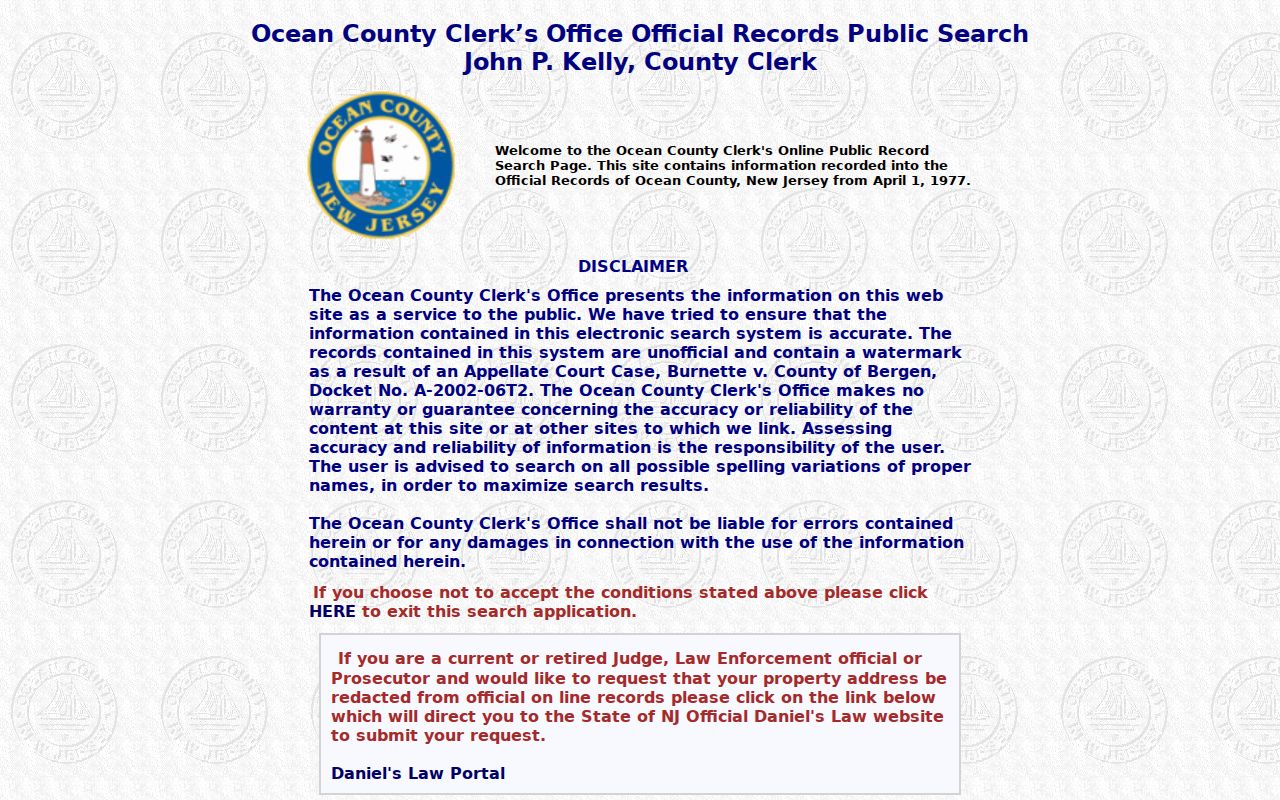
The index supports parcel and party research, but the page's result controls and image availability should be checked for the particular instrument before relying on a copy.
- Grantor
- The party transferring an interest in a recorded instrument, often the seller in a deed.
- Grantee
- The party receiving an interest in a recorded instrument, often the buyer in a deed.
- Chain of title
- The sequence of recorded transfers for the same parcel, checked through matching legal or parcel details rather than names alone.
- Legal description
- The deed's formal parcel wording, such as lot, block, map, or boundary language. It can remain useful when a street name or number changes.
Toms River Previous Residents Before 1977
Ocean County SearchNG states that its official-records index begins April 1, 1977. The research did not establish exact pre-1977 online image or microfilm mechanics, so no particular remote workaround should be assumed. For an older instrument, the documented fallback is the County Clerk's computer-index help, images or hard-copy channel, then courthouse or office records, microfilm, State Archives, library catalog holdings, OCHS material, or a targeted OPRA request for an existing record.
A free index is not a title abstract. The 24-hour courthouse drop box is for document submissions and is processed the next business day, not for instant copies. Keep a request narrow, name the instrument, parcel, volume, date range, or address variant already found, and ask the custodian what format exists. That preserves the distinction between locating a known record and asking an agency to create a new research product.
SearchNG help documents the captured title-search controls, linked documents, and image-related functions.
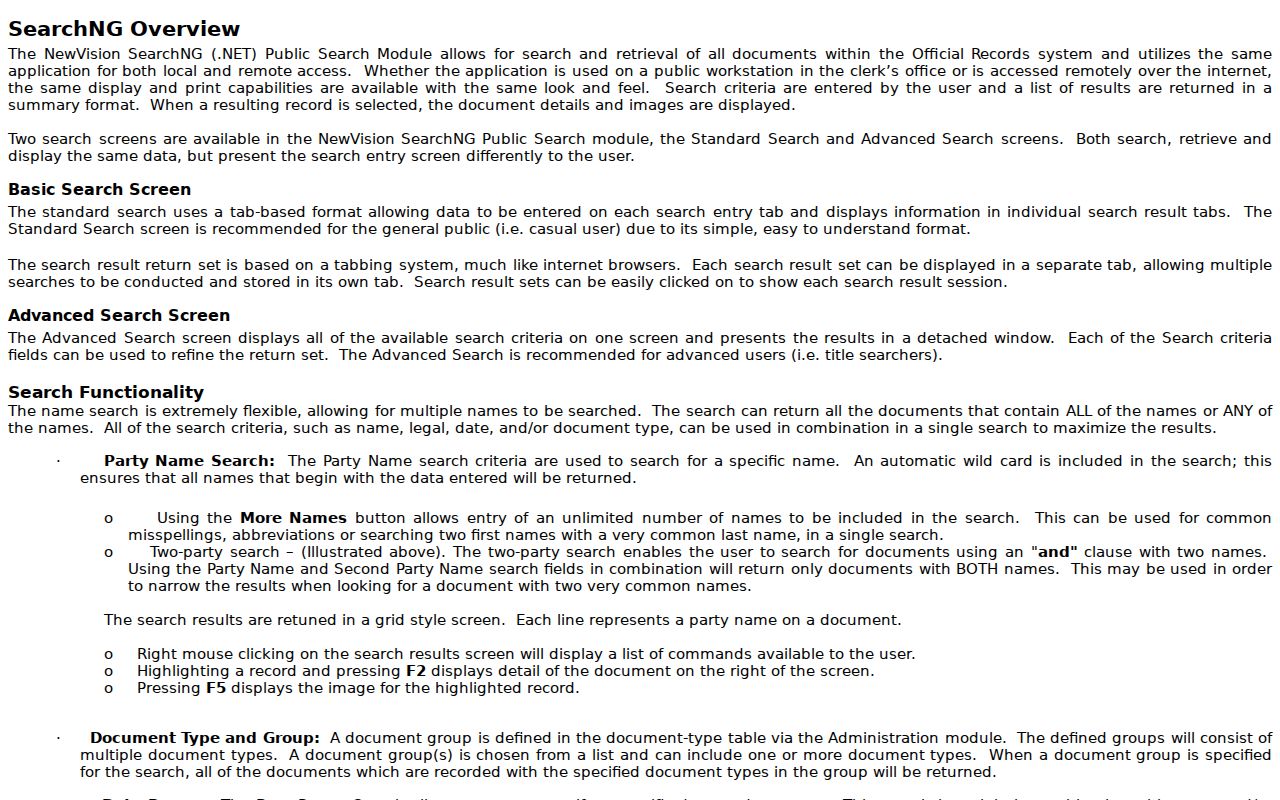
The help material is useful for navigating the recorded-document index, but it does not fill the documented gap in older online coverage.
Note: The stated 1977 index start is not evidence that older deeds are unavailable, only that their online mechanics were not verified.
Toms River Past Residents in Directories
Deeds identify recorded transfer parties. They do not necessarily identify every household that used an address. For that layer, OCHS has verified phone-directory runs for 1956-57, 1970-2007, 2010, and 2014. The Ocean County Library catalog exposes 33 city-directory subject items, including 12 microform, but not a complete local year sequence. The exact volume, its order, and reverse or criss-cross content should be confirmed with Wheeler Room staff before drawing a conclusion from an address.
Copy the street spelling, number, household surname, occupation or business line if printed, and nearby names. Then repeat the same address in the next available edition. A missing name can reflect a move, death, marriage, spelling variation, publication gap, or edition error. Search the related surname, spouse, occupation, business, street, and former street name rather than treating one absence as proof of departure.
The cataloged collections and how to read their entries are covered in the Toms River City Directory collections. Here, they serve as dated household clues in an address trail rather than as a full historical shelf survey.
Toms River Census and Directory Trail
Pair a directory date with the nearest released federal census. A census can add household composition, age, and relationship context, while a phone or city directory gives an intervening-year address and possible occupation. Public federal schedules follow a 72-year release rule, so later directory years may not yet have a public census counterpart. OCHS abstracts and other dated local records can help bridge a period, but they should be cited as their own source.
Address in a dated directory → same spelling or variant in the next held edition → released census household → OCHS obituary, funeral, or family-file clue → deed or probate check.
The flow can reveal a change, but it cannot prove the reason without a supporting record. Keep the directory's own wording and year. A Dover address printed before the 2006 name change should be searched as Dover as well as Toms River.
Toms River Maps and Sanborn Limits
The Library of Congress 1872 Ocean County landowner map is a verified pre-address-history source with Toms River insets, householders' names, lots, business directories, and statistical tables. It can connect a parcel or surname to an earlier local setting, but it is not a deed or a city-directory volume. Use it alongside a later parcel, directory, or recorded-instrument clue instead of treating it as a complete occupancy record.
Sanborn maps offer a different view. The Library of Congress Sanborn guide explains that a verified record can provide a city, edition date, sheet count, and digital-file status. No official item specifically naming Toms River, Dover Township, or a Toms River edition was verified in the research. Check the LOC database and Wheeler Room before claiming a local volume or date.
The comparison matters: GIS locates and inventories a modern parcel but disclaims a legal description; a deed supports recorded transfer and legal parcel evidence; a historic map provides a dated geographic snapshot. Each fills a different part of a house-history question.
Toms River Address Name Quirk
Older records may use Dover or Dover Township because the municipality changed its official name to Toms River in 2006. Street names can be another trap. The 1973 ordinance includes changes such as Dover Avenue to Division Street, Dover Street to Rosewood Drive, and First Street to Canoe Street. Search old and current forms with the block and lot, surname variants, and the municipality name to avoid missing a related instrument or directory line.
The parcel identity can be steadier than a street number. A street number may change, and a legal description may not repeat the modern address, but matching map, lot, block, parcel, and legal-description details can show whether a historical record concerns the same place. Preserve the original wording in notes before translating it into a current label.
Toms River Previous Residents Endpoints
Obituaries and probate can close or clarify an address trail. OCHS indexes local newspaper notices and holds funeral records, while the County Surrogate holds probate and estate filings. An obituary can identify a spouse, children, former address, funeral home, and community affiliations. A probate file can identify a decedent, executor, heirs, attorney, and estate chronology. Sensitive probate material may be restricted, and a named heir is not automatically a current owner.
The Historical Society also has family files, church and justice-of-the-peace marriage material, cemetery records, Bible records, maps, and miscellaneous deeds. Its local newspaper indexes cover births, marriages, and obituaries from 1852 through 1968, with named notice runs also recorded. These collections are an on-site and staff-assisted route when an address disappears from a directory or a deed chain reaches a family or estate transition.
Lawful use. Use Toms River previous-resident records for family history, estate research, house history, or personal curiosity. Do not use a historical address trail to stalk, harass, or harm any living person.