
Toms River City Directory Holdings
Toms River's historical city directories live in two places. Two repositories hold the material: the Ocean County Library and the Ocean County Historical Society. Cataloged directory subjects, microform, telephone books, graduate files, newspapers, maps, and family material sit across both. No single format covers everything. One may hold a name. Another may skip it. Match the source to the date you need, then ask the repository to confirm the specific volume, its condition, and whether a reverse or criss-cross section exists.
| Collection | Years | Where Held | Access |
|---|---|---|---|
| Ocean County phone directories | 1956-57; 1970-2007; 2010; 2014 | Ocean County Historical Society Research Center | On-site research; verify editions and gaps with staff. |
| Cataloged city-directory subjects | 33 subject items, including 12 microform items; exact local runs not exposed | Ocean County Library Wheeler Room and catalog | Ask for Toms River or Ocean County facets and reverse-directory availability. |
| Toms River High School graduate files | 1921-1970 | Ocean County Historical Society Research Center | On-site name and class-year research. |
| Local newspaper notices and indexes | 1852-1968, with named notice runs also reported | Ocean County Historical Society Research Center | Ask for the newspaper title, issue, clipping, or index entry. |
The library catalog points to city directories of New Jersey plus a City Publishing cross-reference directory. Publishers named include Wm H. Boyd, City Publishing Company, and William Mull Butler. The catalog offers no item-by-item Toms River year list. A shelf or microform request settles that question. Staff can pull the specific volume.
Note: A missing catalog year does not establish that no directory was printed or retained elsewhere in Ocean County.
Toms River City Directories in Wheeler Room
Start at the Ocean County Library Toms River branch. Local history lives upstairs. The second-floor Wheeler Room identifies old city directories and phone books alongside rare books, pamphlets, magazines, Ocean County yearbooks, maps, and atlases. A local-history librarian staffs the room. Genealogy instruction recurs there too. That makes it a strong first stop when the online catalog supplies only a broad subject record. The address is 101 Washington Street. Hours run Monday through Thursday 9 a.m. to 9 p.m., Friday and Saturday 9 a.m. to 5 p.m., and Sunday 1 p.m. to 5 p.m.
Free access at library locations covers New Jersey property records and maps. The scope is wide. Historical records from 1989 to the present are included, along with assessment information, tax maps, zoning, GIS street maps, and related materials. Those sources can test an address found in a directory. They cannot replace the older volume. Ask the Wheeler Room about the directory itself first. Use current property material only as a separate comparison.
Ocean County Library's property-records resource page shows the kind of local records assistance available at library locations.
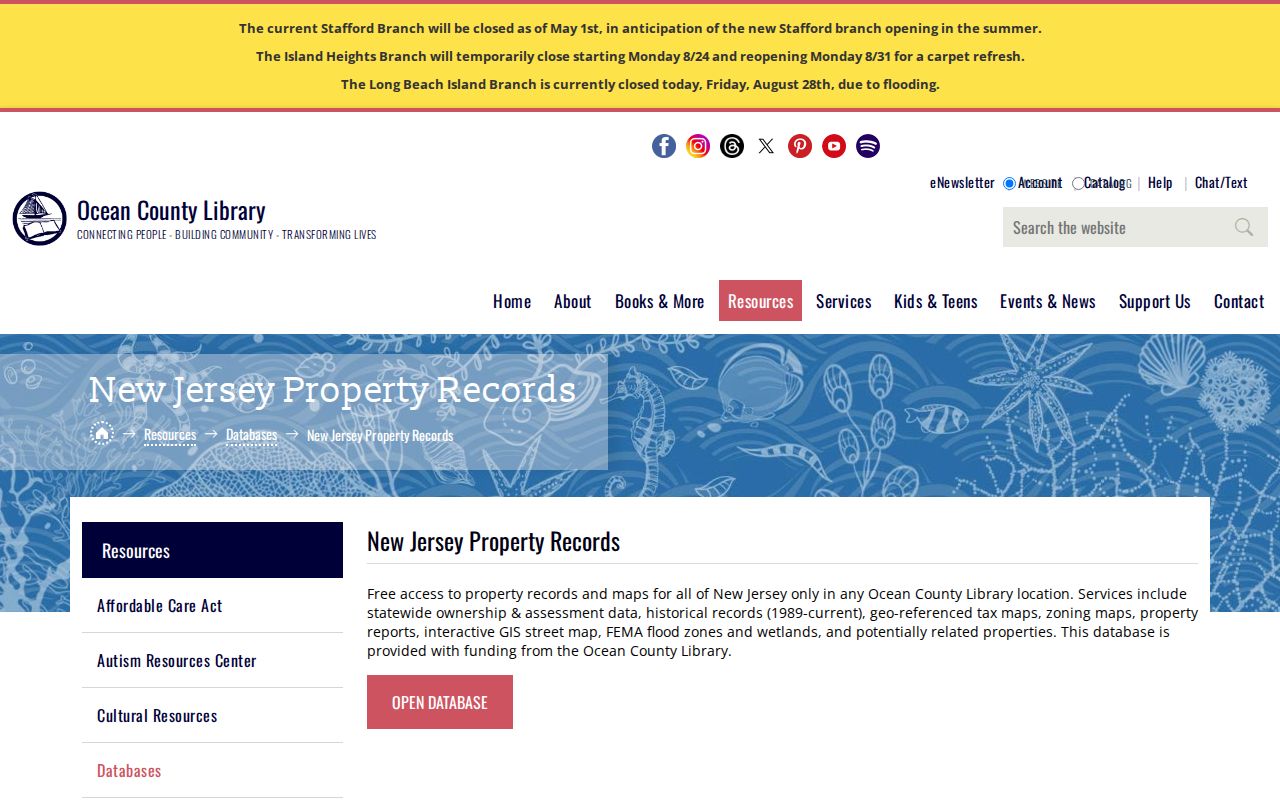
Directory questions, maps, and property context can share one visit. Keep historical directory evidence separate from modern parcel data.
Toms River Directory Runs at OCHS
The Ocean County Historical Society Research Center documents the clearest verified local phone-directory run: 1956-57, 1970-2007, 2010, and 2014. The gaps are important. A name absent in the next held edition may reflect a missing local volume, a spelling change, a move, a death, a marriage, an omission, or an edition error. Search a spouse, occupation, business, nearby surname, and street before drawing a conclusion from one absent entry.
Its collection extends beyond phone books to family-name files, maps, surveys, newspapers, yearbooks, photographs, tavern licenses, ledgers, cemetery and funeral material, and digitized resources available on site. Staff can point visitors toward existing family files, summaries, and scans; the Society also allows a visitor to start a family file when a surname is not already represented. This makes the Historical Society a strong fallback after a Toms River city directory search produces a partial lead.
The Historical Society holdings page identifies the research collections and on-site access context.

One surname search can lead from a phone book to a newspaper index, family file, map, or yearbook. No single source tells the whole story.
Toms River City Directory Catalog Clues
The Ocean County Library city-directory catalog search lists 33 subject items. Twelve are microform. Facets reach Ocean County, New Jersey, Newark, and Toms River. That proves the directory shelf is real and searchable. It is not a published Toms River chronology. Confirm exact call numbers, publishers, and year runs with Wheeler Room staff before a trip or a citation.
A catalog subject can open several doors. It may point to an alphabetical volume, a cross-reference work, microform, or a nearby regional directory. Write down the title, publisher, year, format, and repository before copying any person or address. Care here prevents mix-ups. That habit saves trouble later. A similar New Jersey place name can easily be mistaken for Toms River, and the trail stays checkable by another family researcher.
The library catalog result is a practical starting point for subject and microform filters.
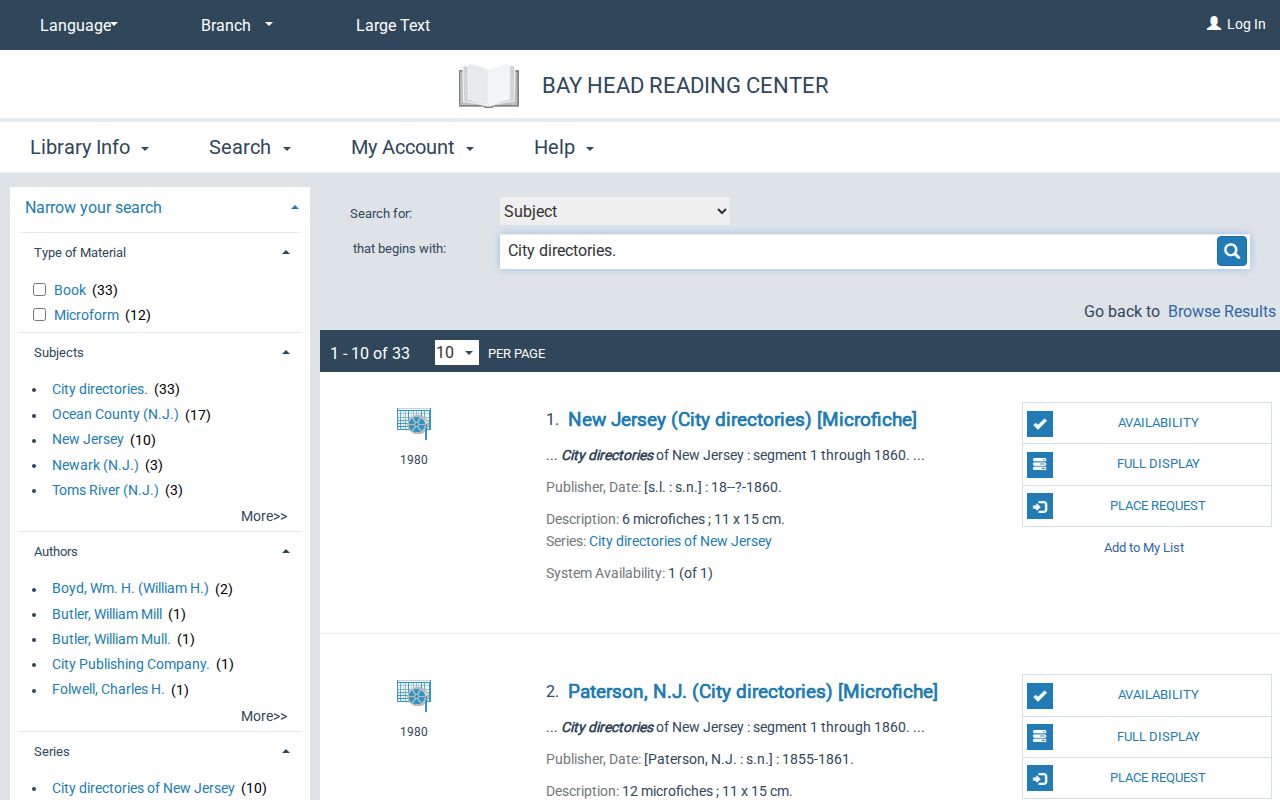
Facets can help frame a staff request. They cannot replace the item record or the volume.
Reading a Toms River City Directory Entry
The volumes are locatable through catalog and collection descriptions, though not every Toms River entry is known to hold each field. Read the front pages and the individual line together. A published key to abbreviations usually sits at the start of a volume. Treat the fields below as likely rather than guaranteed.
| Surname and given name | Copy the spelling, initials, punctuation, and any household notation exactly. |
|---|---|
| Spouse or household note | Record it only if printed, including parentheses or other punctuation. |
| Occupation or organization | Note a listed occupation, business, or organization without treating it as an address confirmation. |
| Street address | Preserve the house number, street spelling, and whether the volume is alphabetical or address ordered. |
| Volume reference | Capture the year, page, title, publisher, and any printed key before leaving the repository. |
Careful transcription beats guessing at unfamiliar shorthand. A short key can change from one publisher or year to the next. Photograph or copy the title page and abbreviation key where the repository permits it, then keep that material beside the extracted line.
- Criss-cross directory
- An address-first or street-ordered directory section used to move from a location to listed names. Confirm that a requested local volume includes one.
- Householder index
- A name-oriented listing intended to identify a household or primary listed person; its exact scope depends on the volume.
- Abbreviation key
- The publisher's printed explanation of shortened terms and marks. It is the only reliable basis for interpreting a symbol in that edition.
Note: A directory line is historical evidence, not proof that every person at that address appears in the volume. Treat each Toms River residents directory entry as a clue worth confirming against a second record.
Toms River Directory Name Quirk
Every Toms River search needs a Dover variant. The township's first surviving minutes date to March 1783, when the jurisdiction was still Dover. The municipal name did not change from Dover to Toms River until 2006. An older directory, marriage abstract, family file, minute book, or map may therefore preserve the Dover wording. A reader may still expect the newer form. Record the place name the source itself uses. Then search the alternate form rather than silently modernizing it. The historical sequence reaches well beyond printed directories. Ocean County formed in 1850. The 1872 Beers landowner map predates the phone-book runs. It still shows Toms River insets, householders' names, business-directory material, and statistical tables. The Toms River city directory record is one layer in that longer local record system. It is not the beginning of it.
| 1783 | First surviving township minutes date to the Dover era. |
|---|---|
| 1850 | Ocean County formed, with Toms River as county seat. |
| 1872 | Beers map supplies a pre-directory landowner and business reference. |
| 1956-57 | Earliest verified OCHS phone-directory run begins. |
| 2006 | Dover Township name changed to Toms River Township. |
Tracing Toms River City Directories
A household trail gains strength when it moves one edition at a time. It also records what changed. Directories can supply intervening-year address and occupation evidence. A census adds the wider household and age context. Federal census schedules are restricted for 72 years. Recent directory years may not pair with a public census schedule yet. The Ocean County Historical Society's local files can sometimes add abstracts. They can also offer a different record type during that gap.
- Locate the earliest available Toms River city directory or phone-book entry for the surname, then copy its exact spelling, address, occupation, and nearby names.
- Check the next held edition and repeat the transcription rather than relying on a single year.
- Search a spouse, business, occupation, or neighbor when the name vanishes or the spelling shifts.
- Pair the dated line with the appropriate public federal census year, noting that the census supplies household composition while a directory may fill years between enumerations.
- Use OCHS newspaper, obituary, cemetery, funeral, and family-file resources to test whether a move, death, marriage, or local connection explains the change.
For a historic address, keep the street spelling and number exactly as printed. A Dover address may need a Toms River search as well. Local street changes can force an older street name into play. When the question shifts from a historical household to an address-based record trail, current parcel or deed research belongs on the Toms River streets page. Note: An unexplained gap is a reason to test related records, not a reliable date of departure from Toms River.
Toms River City Directory Companions
School files and yearbooks can place a name in a local class or community setting. That helps when a directory volume runs thin. OCHS identifies Toms River High School graduate files covering 1921 through 1970. Central Regional files span 1957 through 1965. St. Joseph's files cover 1970 through 1974. Ocean County Library and OCHS also hold yearbooks. Exact runs are not stated for every title. Record the class year, school, and volume before connecting it to an address or family file. The same repositories hold newspaper notices, local marriage material, cemetery and funeral records, Bible records, and "200 Families of Old Dover" booklets built on census, cemetery, birth, death, funeral, and Bible sources. These records suit family history work and reconnecting with former classmates. Cite each one by repository, title or volume, page, and date. None of them proves that a particular person appears. The Toms River branch listing provides the Wheeler Room contact point for questions about its local-history shelf.
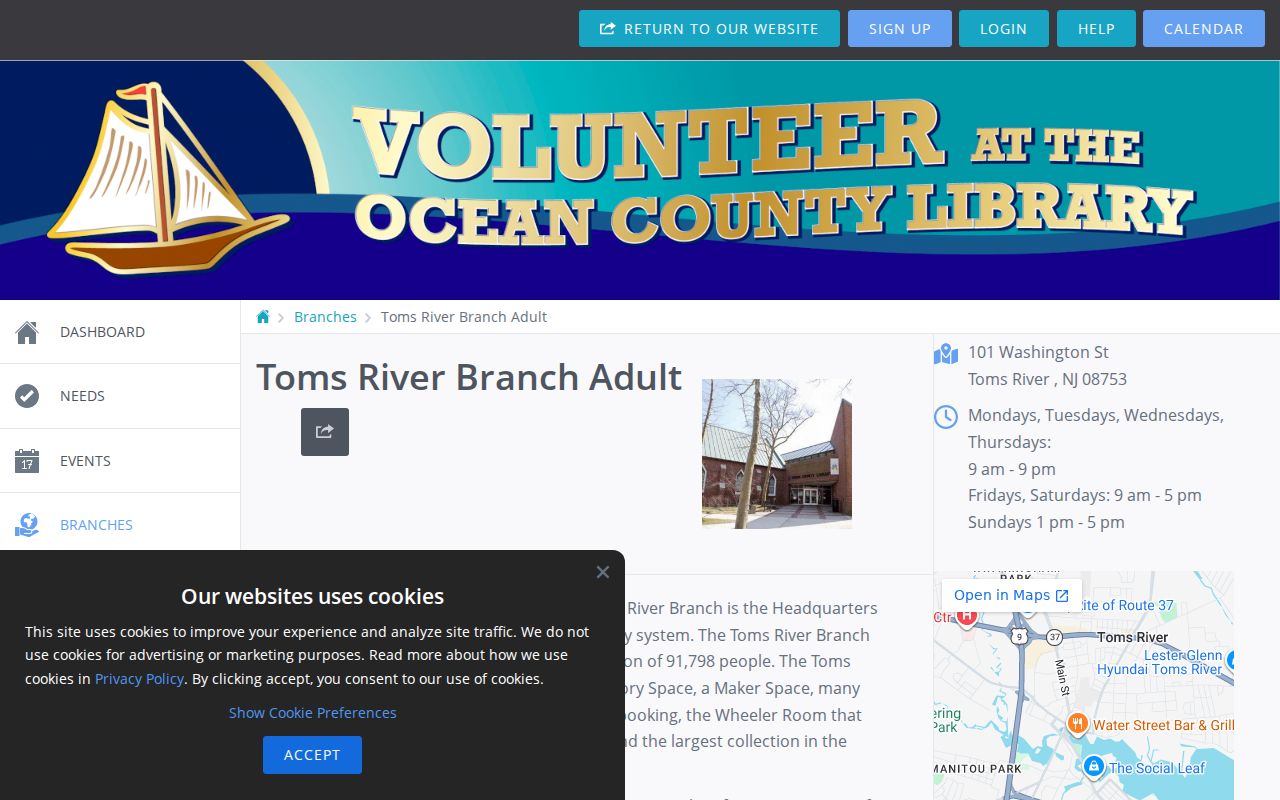
The branch record offers a practical local contact for a specific volume, a missing directory year, or related yearbook and newspaper research.
Toms River Before City Directories
The Library of Congress 1872 Ocean County landowner map is a useful pre-directory source. Its Toms River insets show rural buildings and householders' names. They also carry business directories and statistical tables. It can connect a person or property to an earlier local setting. It is not, however, a replacement for a printed city directory. Compare a map name against a family file, deed, tax map, newspaper notice, or later phone-book entry. Do that before treating it as a continuous address trail. The contrast is useful. A directory or phone book can place a listed person in a publication year. The map instead supplies a broader landowner and place snapshot. Both can carry spelling variants, and both need a source citation. Neither one proves a complete household roster.
Toms River Newspaper Digitization
Newspaper records in Toms River may soon get easier to search. An Ocean County Library project plans to digitize more than 40 years of the Ocean County Leader. It is backed by a 2025 New Jersey State Library award. Searchable online access is intended by summer 2026. The named coverage leans toward Point Pleasant Beach, Bay Head, Mantoloking, and Lavallette. So don't assume a Toms River notice will appear there. The State Library award description spells out the project status.
Until then, OCHS is the proven newspaper-index route for the area. Its holdings include obituary, marriage, and birth indexes covering 1852 through 1968. Other on-site material sits there too. Ocean County Library also offers Ocean County Observer coverage from December 17, 2002 through January 10, 2008. It comes through ProQuest US Newsstream. Be aware of the gaps, though. Many Asbury Park Press obituaries from 1999 through 2005 are incomplete. Licenses and coverage shift over time. So confirm which databases the library currently offers before counting on them.